

In this lesson you will find out
- Which words this course uses for people and families
- What zygote, embryo, blastocyst and fetus each mean
- Why embryology and pregnancy care count weeks about two weeks apart
About 4 minutes. At the end you will find one quick question, a short summary and the button to your next lesson.
Two small things cause a surprising amount of confusion in embryology: the words used for people and cells, and the way weeks are counted. This lesson settles both before you start.
Words for people
This course uses the words “male” and “female”, “men” and “women”, and “partner”. It explains the biology of eggs and sperm in plain terms. Every family is welcome here, however it is made, including families created with donor eggs, donor sperm or a surrogate.
Words for the stages of life
Scientists use different names for a new life as it grows. You will meet each one in turn, and they are gathered here as well.
- Zygote
- The single cell formed when a sperm and an egg have joined, before it first divides.
- Embryo
- The developing life from fertilisation until the end of week 8 after fertilisation. At the single-cell stage it is called a zygote.
- Blastocyst
- The embryo from about day 5 to 6 (sometimes day 7): a hollow ball of cells with an inner cluster.
- Fetus
- The developing baby from week 9 after fertilisation until birth.
- Gestational age
- Pregnancy age counted from the first day of the last menstrual period.
Two clocks for counting weeks
There are two ways to count the age of a pregnancy, and they differ by about two weeks. Embryology counts from fertilisation, while doctors, midwives and scan reports count from the first day of the last menstrual period, so week 6 after fertilisation is about 8 weeks of pregnancy. The first time a week appears in a lesson you will see both, and Module 2, lesson 2 explains the two clocks in full.
“A pregnancy that is “8 weeks” has been growing for 8 weeks.”
When counted from the last period, an 8-week pregnancy has usually been growing for about 6 weeks since fertilisation, because the first two weeks of the count come before ovulation.
In IVF the date of fertilisation is known exactly, so clinics can calculate the due date from the embryo transfer date and the embryo’s age. Your clinic will tell you the pregnancy dates it uses.
Check your understanding
A scan report says a pregnancy is 10 weeks. About how many weeks ago was the egg fertilised?
Scan reports count from the last period, which is usually about two weeks before fertilisation. So 10 weeks of pregnancy is about 8 weeks after fertilisation.
Embryology counts from fertilisation; pregnancy counts from the last period, about two weeks earlier. This course gives both, so you never have to guess.
Lesson summary
What you learned in “A note on words and weeks”:
- The course uses the words male and female, men and women, and partner, and every family is welcome, however it is made.
- A new life has different names as it grows: zygote, embryo, blastocyst and, from week 9 after fertilisation, fetus.
- Embryology counts weeks from fertilisation, while doctors, midwives and scan reports count from the first day of the last menstrual period.
- The two clocks differ by about two weeks, so week 6 after fertilisation is about 8 weeks of pregnancy.
- In IVF the date of fertilisation is known exactly, and your clinic will tell you which pregnancy dates it uses.
Up next Module 02, lesson 1
That was the last lesson of Module 01. The next module is The big picture: from two cells to a newborn.
The whole story on one page A map of human development from egg and sperm to birth, so every later module has a place to sit. 4 min read Start Module 02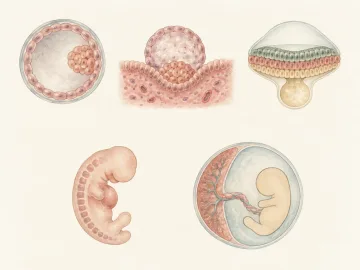
Your progress is saved in this browser only.

In the ebooks: Book One, chapter 1: Fertility: The Basics Everyone Should Understand