
In this lesson you will find out
- Who Kara is and the training behind this course
- What an embryologist does in an IVF laboratory
- What this course can explain, and what it cannot tell you
About 3 minutes. At the end you will find one quick question, a short summary and the button to your next lesson.
This course is written in the voice of Kara Raubenheimer, the founder of Fertility with Kara. Kara is a Reproductive Biologist registered with the HPCSA, with 17 years of experience and a master’s degree in medical physiology from Stellenbosch University. As an Embryologist, she created Fertility with Kara to bring that knowledge out of the laboratory, so that the words you hear at an appointment already make sense before you walk in.
What an embryologist does
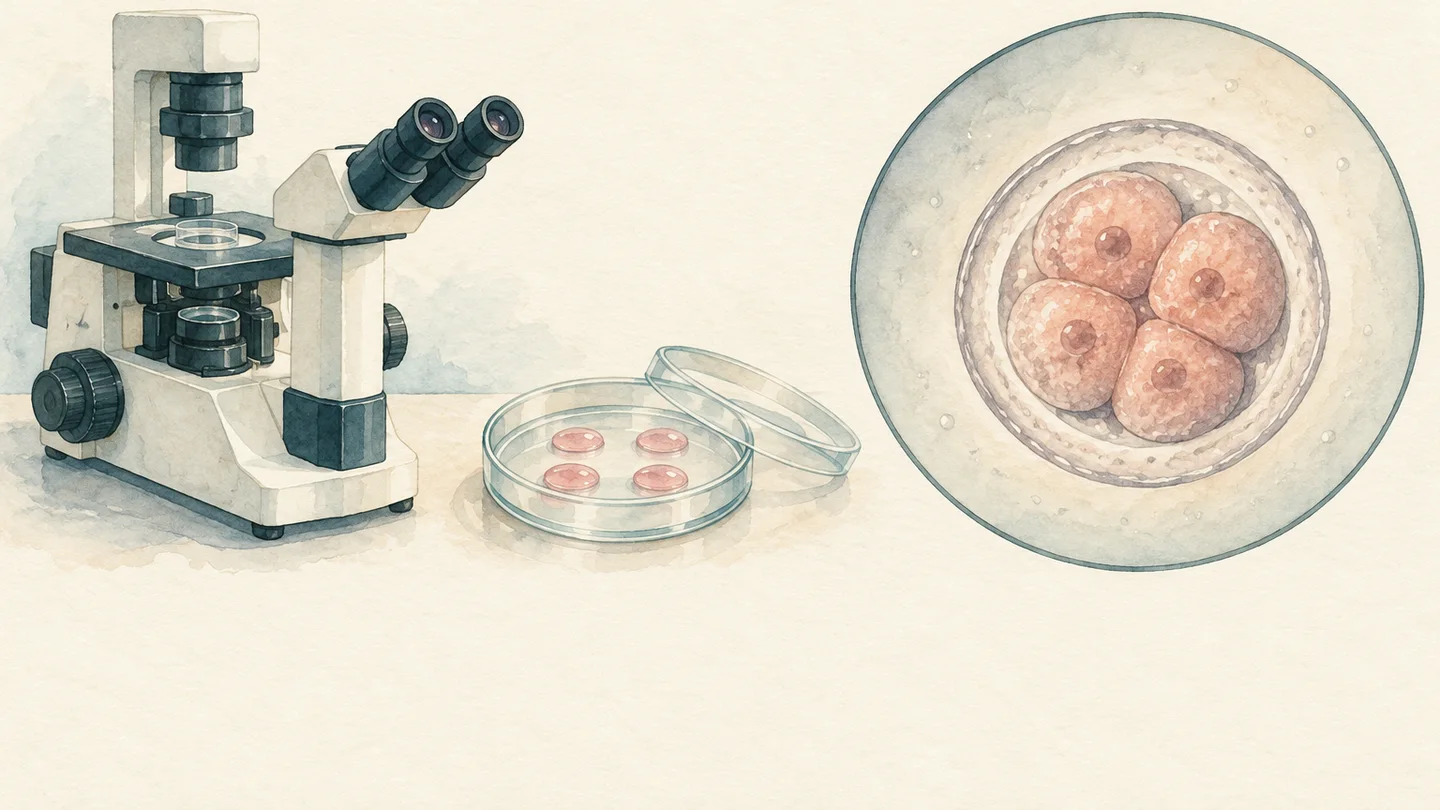
An embryologist is a scientist who works with eggs, sperm and embryos in the laboratory. In an IVF lab, embryologists prepare sperm, check eggs for maturity, fertilise them by IVF or ICSI, watch each embryo develop day by day, decide with the clinical team which embryo to transfer, and freeze and thaw eggs and embryos.
That makes an embryologist one of very few people who see the first days of human life with their own eyes. Most textbooks describe those days from drawings. Part 4 of this course describes them from the bench.
Kara’s research interests
In Kara’s own words, she studied thousands of IUI and IVF/ICSI treatment cycles at Genesis Reproductive Centre and Wilgers Infertility Clinic, private fertility laboratories in South Africa, comparing oocyte meiotic spindles and morphology, as well as semen preparation techniques, sperm shape and DNA integrity, as indicators of assisted reproductive success. She has also designed research in reproductive biology on whether a man’s age and the integrity of sperm DNA relate to fertility and treatment outcomes.
The words in an embryo report stop being frightening the moment you know what the cells actually look like. I have seen that happen many times. That is why this course has so many drawings, and why it starts with the very first cell.
What this course is, and is not
This is an education course. It explains how things usually happen, and what the evidence shows on average. It cannot tell you what is happening in your own body, your own cycle or your own embryos. For that, the right person is your own doctor or fertility clinic, and many lessons end with questions you can take to them.
Check your understanding
Which of these is part of an embryologist’s work in an IVF laboratory?
Doctors perform egg collection and prescribe medicines. Embryologists work with the eggs, sperm and embryos in the laboratory.
Your teacher is an embryologist: someone who watches the first days of life through a microscope. This course shares that view with you, as education rather than personal advice.
Lesson summary
What you learned in “Meet your teacher”:
- The course is written in the voice of Kara Raubenheimer, a Reproductive Biologist registered with the HPCSA, with 17 years of experience.
- Kara holds a master’s degree in medical physiology from Stellenbosch University and created Fertility with Kara to bring that knowledge out of the laboratory.
- An embryologist works with eggs, sperm and embryos in the lab, from preparing sperm and checking eggs to freezing and thawing embryos.
- Because embryologists see the first days of life with their own eyes, Part 4 of the course describes those days from the bench.
- This is an education course about what usually happens, so questions about your own body or embryos belong with your doctor or clinic.
Up next Lesson 1.3
A note on words and weeks The words this course uses for people, and the two different clocks for counting weeks. 4 min read Start the next lesson
Your progress is saved in this browser only.

In the ebooks: Book One, chapter 1: Fertility: The Basics Everyone Should Understand